 Orthodoxy in America.org
 Articles on Orthodox Education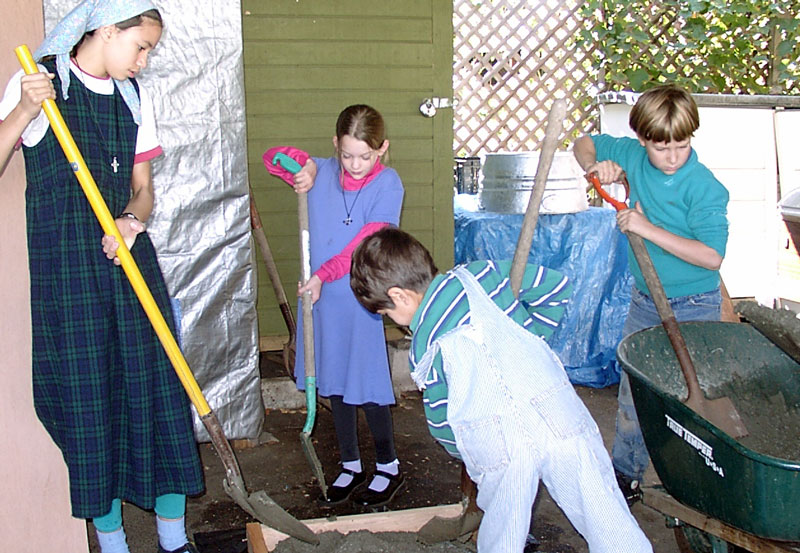
The Spiritual Benefits of Physical Labor
Physical labor can have a powerful influence on the soul. Anyone who reads even a little of the writing of the Holy Fathers quickly comes across the phrase "love of labor". The effort involved in physical labor can be a great help in developing the strength and inclination to labor spiritually. In fact, a child who is not expected to exert himself physically will hardly be inclined to exert himself spiritually. Some sort of physical labor should therefore be a part of an Orthodox curriculum if the curriculum is to revolve around the effort to form the soul of the child, not just inform the brain.
Most of us have a sense of what the phrase “inform the brain” means, but what does “form the soul” mean? How is our soul formed? Did not God make it whole and complete? We know that prayer and good deeds are beneficial for our soul, and sin is bad for our soul, but our idea of the soul may not go beyond that.
The early Church Fathers had a much clearer concept of the soul and we can gain much by studying their writings. Fortunately, God has provided us with a few saints of modern times who have immersed themselves in the writings of the early Church and can pass on this knowledge to us. St. Theophan the Recluse, in his book, The Path to Salvation, gives us an excellent primer on the soul. St. John of Kronstadt’s My Life in Christ echoes the same understanding and insights.
The Church teaches that man's soul is trinitarian, in the image of the Divine Trinity Who created it. This trinity is seen in three aspects or capabilities, usually referred to as “mind, heart and will”, or “thinking, feeling, and acting”. A Christian education must be designed to engage all three capabilities of the soul, not just the thinking or intellectual part. Thus the whole soul - heart, mind and will - is given opportunities to come to the knowledge of God.

We would like to share one way we have designed our curriculum to provide activities for the right formation of the will. As parents and teachers, we all know that children have a will, and that certain uses of this will call for needful disciplinary actions. We also know that that the use of this same will can produce wonderful surprises, such as a "breakfast in bed" for mom on a special occasion, or a clean bedroom one day - without even being told.
Children find such satisfaction when they discover they can do something that brings delight and amazement to others. In school, we attempt to capitalize on this natural, positive inclination by providing opportunities to serve others through simple chores and larger service projects. A few times a week we put down the books and each student is assigned a cleaning task. Within a few minutes the entire school is cleaned, dusted and vacuumed, and the porches and sidewalks are swept.
Often on Friday morning, after shorter lessons, time is spent on service projects. Many times it is an outdoor project involving gardening, construction or property maintenance. Other times it is assembling The Eagle, the newsletter of our friends at St. John's Mission in Kodiak, Alaska. We have also made treats for neighbors and friends.
Of course, the jobs are not always easy or even pleasant. The children then have an opportunity to struggle against the laziness of the flesh and to conquer the reluctance to so something that is not "fun". Sometimes it involves hard physical labor, such as using sledgehammers to break up concrete in the old fishpond. Other activities, such as carefully planting seeds or bulbs, or painting the fence, become lessons in patience and attending to detail. Everyone must learn to work cooperatively, diligently and cheerfully. These are perfect times to teach the necessity of a work well done. We have learned that the best way to accomplish this is to work alongside and with the children, showing and teaching by word and example.
We adults too often think it faster and easier to just "do it ourselves". Yet in doing this we rob the children of many things. When an adult works joyfully with a child, the child learns much more than how to perform a task. The struggles endured together produce many other rewards. The child sees that he is needed and loved and gains a respect for physical labor and for himself. Many times we have seen a child glow with true joy after finally completing a difficult task. Becoming confident in new skills and abiities contributes to a healthy self-respect that leads to even greater efforts to the glory of God. Even more importantly, developing a love of physical labor is related to developing a willingness to labor spiritually. Although a child accustomed to physical labor may not transfer that willingness to spiritual struggles, it is certain that a child untrained in physical labor will not labor spiritually. This is the reason for the Patristic emphasis on physical labor.
Children find such satisfaction when they discover they can do something that brings delight and amazement to others. In school, we attempt to capitalize on this natural, positive inclination by providing opportunities to serve others through simple chores and larger service projects. A few times a week we put down the books and each student is assigned a cleaning task. Within a few minutes the entire school is cleaned, dusted and vacuumed, and the porches and sidewalks are swept.
Often on Friday morning, after shorter lessons, time is spent on service projects. Many times it is an outdoor project involving gardening, construction or property maintenance. Other times it is assembling The Eagle, the newsletter of our friends at St. John's Mission in Kodiak, Alaska. We have also made treats for neighbors and friends.
Of course, the jobs are not always easy or even pleasant. The children then have an opportunity to struggle against the laziness of the flesh and to conquer the reluctance to so something that is not "fun". Sometimes it involves hard physical labor, such as using sledgehammers to break up concrete in the old fishpond. Other activities, such as carefully planting seeds or bulbs, or painting the fence, become lessons in patience and attending to detail. Everyone must learn to work cooperatively, diligently and cheerfully. These are perfect times to teach the necessity of a work well done. We have learned that the best way to accomplish this is to work alongside and with the children, showing and teaching by word and example.
We adults too often think it faster and easier to just "do it ourselves". Yet in doing this we rob the children of many things. When an adult works joyfully with a child, the child learns much more than how to perform a task. The struggles endured together produce many other rewards. The child sees that he is needed and loved and gains a respect for physical labor and for himself. Many times we have seen a child glow with true joy after finally completing a difficult task. Becoming confident in new skills and abiities contributes to a healthy self-respect that leads to even greater efforts to the glory of God. Even more importantly, developing a love of physical labor is related to developing a willingness to labor spiritually. Although a child accustomed to physical labor may not transfer that willingness to spiritual struggles, it is certain that a child untrained in physical labor will not labor spiritually. This is the reason for the Patristic emphasis on physical labor.